Tuesday, March 9, 2010

A grasshopper wee, and miscellaneous flora

Here in Ohio, snow has cloaked the landscape in a dense layer of fluff nearly all winter. Temperatures have been decidedly frosty as well, making one really yearn for something green. So, last Sunday, some of us headed afield in Adams County to see if any early flora could be found. Down there, hard on the banks of the mighty Ohio River, the broad valley of this 120,000 year old stream has its own microclimate. Winter's temperatures are moderated, and things heat up much earlier in spring. Get around some of the rock outcrops, and one should find a number of early-blooming wildflowers by now.

But it was not to be. This winter has been tough enough to turn Al Gore pink-faced with chagrin, and the plants just haven't popped. I bet by now, just days after the foray reported upon herein, many wildflowers are out, so quick are they to burst furth given a bit of warm weather and liberation from the snow coat.

We did find lots of interesting things - that's ALWAYS the case on one of our forays - and a few are pictured below.

A must-stop was Sandy Springs Cemetery, an old cacti-choked graveyard on one of the best remaining riverine sand terraces along the Ohio River. Our attention was quickly drawn to these tiny hirsute bees (we think they are bees), which were perhaps one-quarter inch long, many of which were patrolling low over the sands.

We were very interested in these bees, and spent perhaps too much time following them to see what they might be doing. Questions arise: What do they eat? Why are they out so early? Do they nectar at plants? If so, what? And so it goes.

It didn't take long to realize that the little bees were seeking suitable digging grounds. In the above photo, one has tunneled into the loose sand until only its tail end protrudes. In short order, it was completely buried and the sands had completely hidden it. A nest, possibly to become the crypt of some hapless paralyzed bug that will be Jr. Bee's first meal?

A healthy SPROING diverted our attention to this Lilliputian chap; an early instar of some species of grasshopper. It's extremities were flushed with rose, creating a showy contrast of colors. I am always curious about obscure animals in rare and odd habitats such as this; oftentimes they turn out to be something special. Even though this little fellow was perhaps 1/3 inch in length, it still could jump perhaps 75-100 times its body length.

Everyone knows our state tree, the Ohio Buckeye, Aesculus glabra. I think there is a football team named after that plant. Perhaps not all know that we've got a second buckeye - this one, the Yellow Buckeye, Aesculus flava. Taller and more stately, it occurs in our southern counties. At this site along a small stream, both species were present, with the yellows occupying higher slopes and the Ohio on the flats of the stream terrace.

The stump of a Black Locust, Robinia pseudoacacia, a large woody pea family member. This cutaway view enables us to see how quickly this species can grow - there are only about 15 or so annual growth rings, some of which are nearly the width of that penny.

We were excited to encounter this fine specimen - no, not the model, Bob Placier - but the green tree. It's a big American Holly, Ilex opaca. It was WAY off the beaten path, in a remote area far from roads or homes. This plant is a bit of an enigma in Ohio, which is at the extreme northern limits of its range. Undoubtedly native to lands along the Ohio River, it also escapes and one can really never be sure whether a "wild" holly is really wild. But when I see them in spots such as this, I do figure that they are natives, even if bird-assisted.

The beyond ripe fruit of Buttonbush, Cephalanthus occidentalis, dangle over a vernal pool, the gnarled contorted branches of the shrubs forming the backdrop. Buttonbush is a classic plant of swamps.

A light compression of the fingers and all of the individual achenes shattered from the ball-like fruit clusters. This is a good strategy - delayed ripening - for a plant intimately associated with watery habitats. Hold onto your fruit until the first rains of spring, then drop them in the drink to be carried off either by water or migrant Wood Ducks.

Following a similar strategy as the Buttonbush, the boxlike fruit of Seedbox, Ludwigia alternifolia, hold tight to their seeds until spring. Each little container contains myriad dustlike seeds, easily waterborn. This is a gorgeous little wetland herb with showy yellow flowers in addition to its namesake distinctive fruit; I'm not sure why it isn't utilized as a native rain garden plant. Maybe THIS CONFERENCE will help to change that.

Large orbicular masses of Mistletoe, Phoradendron leucarpum, clung to the crowns of elms, maples and oaks on the banks of the Ohio. This interesting hemiparasitic plant is near the limits of its range along the Ohio River, and it can be quite common in places. The sticky fruit are transported by birds, and if the expelled seed lands on a suitable bough, it augers into the tree via specialized roots called haustoria and begins a long arboreal life.

Finally! A true flowering plant, in flower! This is a Eurasian "weed", but it must be noted that the definition of a weed is in the eye of the beholder. Whitlow-grass, Draba verna, is a tiny mustard that is abundant in dry sparsely vegetated ground. Like many small things, when seen well it is quite showy and multidimensionally interesting. Mustards have four petals; it appears that there are eight on this plant. Each petal is deeply cleft, or bifid, nearly to the base, giving the illusion of an octet of petals.

We did see a few other weedy little species, such as Hairy Bittercress, Cardamine hirsuta, and Smooth Speedwell, Veronica polita, but even these earliest of bloomers were far behind their normal schedule. But make no mistake - the floodgates of spring have cracked open, and it'll be a cascade of plants tumbling forth from here on out.

StumbleUpon.com

Monday, March 8, 2010

Amish Bird Symposium

Last Saturday marked the 7th annual Amish Bird Symposium, held in Adams County, one of Ohio's most special places. And what is an "Amish Bird", anyway? Well, there is a sizable Amish community in the area where the conference is held, and that led to the name.

I've been to all but one of these, and can vouch for what a great event it is. This year, we broke in the brand new community center, filling it with some 300 bird enthusiasts. The organizers - The Nature Conservancy, Cincinnati Museum, Roman Mast, and Tom Cross of the county visitor's bureau - do a wonderful job. The main focus is speakers, and there's always a good lineup.

Lots of exhibitors, too. This is the Ohio Ornithological Society's towering display, and that's board member Ann Oliver (2nd from right) working the crowd. She does excellent work for the organization, and is the driving force behind our newsletter, the Cerulean.

Keynote this year was the inimitable Don Kroodsma, author of The Singing Life of Birds. Don knows bird song like a second language, and his programs are punctuated with plenty of examples of song. He makes people completely rethink the wonders behind even the most commonly heard melodies such as the Song Sparrow.

Ed Schlabach led off with a great talk about rare birds, especially in his native Holmes County, which is becoming the rarity capital of Ohio. Thane Maynard of the Cincinnati Zoo gave a nice talk about formerly rare birds on the road to recovery, and legendary photographer Ron Austing shared many of his incredible bird images. Closing us out was Chuck Jakubchak, who gave an informative program on bird nests.

Be sure and put this event on your calendar for next year. You won't be disappointed.
As we do every year, much of the group went to nearby Adams Lake afterwards, to see what we could see. Not much this year, as ice still crusted much of the lake. Nevertheless, good studies were had of Ring-necked Ducks, a Canvasback and Redhead, and Green-winged Teal, among others. The strident notes of returning Killdeer filled the air, and Turkey Vultures heading north to Hinckley soared overhead.

I stayed overnight, and the next day some of us went on a much more adventurous field trip. We found some really interesting stuff, and I'll be posting about those discoveries soon.

StumbleUpon.com

Thursday, March 4, 2010

Spectacular eiders

Possibly the most coveted duck in North America amongst the birding crowd is the Spectacled Eider, Somateria fischeri. The gaudy and ornate appearance of the drakes led to the nickname “Spectacular Eider”, which this species certainly is.

Sea ducks have a special place in my heart. As a kid growing up in land-locked Columbus, Ohio, the thought of scoters and eiders toughing it out on cold, windy sea coasts fired my imagine and certainly piqued my interest in birds. To me, these ducks were beautiful, mysterious, and mostly unattainable at the time. The license plate above has graced my cars since 2004.

Spectacled Eider drake, courtesy Birds of North America Online.

Goggle-faced with a pea-green mullet, the black and white drake Spectacled Eider is one of the world’s most distinctive species of waterfowl. It’s also one of the toughest, as we shall see.

It was with great interest that I listened to a fascinating program on “specs” at the recent OOS/Columbus Audubon waterfowl symposium. Veterinarian Gwen Myers of the Columbus Zoo and Aquarium has participated in research on this species for the past few summers, spending weeks at a time in the remote Alaskan tundra where Spectacled Eiders breed. Her talk was fascinating; filled with wonderful photos of the tundra and its fauna, and lots of info about specs. Gwen’s talk was a conference highlight and allowed attendees to live vicariously through her exploits.

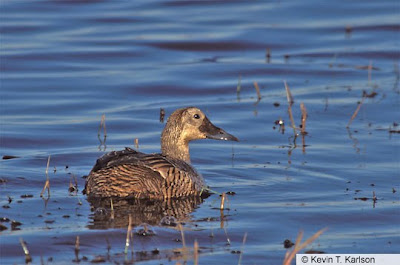
Hen Spectacled Eider, courtesy Birds of North America Online.

Seeing a spec ain’t easy. The Alaskan nesting sites are remote; this is one bird you’ll not see from the car window. They’ve also declined tremendously, shrinking back to three core breeding areas in Alaska. At one time they occurred over much more extensive reaches of the Alaskan coastline. There are many more specs in eastern Russia, but good luck getting to them and the demographics of the Russian populations are poorly known.


Spectacled Eider distribution. Map courtesy Birds of North America Online.

Dr. Myers and crew were choppered in to remote Spectacled Eider country with enough supplies to last a few weeks. Any hardships were countered by the incredible burst of life on the summertime tundra: clouds of waterfowl (and mosquitoes), scores of shorebirds of many species, interesting mammals, and the prolific blush of elfin tundra flora.

Catching a Spectacled Eider is not the easiest task in the world, but catch them they did. Once a bird was caught in mist nets, a variety of data points were collected, then the bird was fitted with a radio transmitter. You can see the antenna projecting from the bird’s back in the above photo. Implanting an antenna and receiver may seem rather invasive, but the results have demonstrated that the tagged birds are not adversely affected. This technology enables researchers to gather basic life history data on a bird that is utterly inaccessible to people most of the year.

In 1993, the Spectacled Eider was listed as Threatened by the U.S. Fish & Wildlife Service. There is no question that populations have declined tremendously in modern times; less clear are the reasons for the losses. The area outlined in red shows the approximate location where most Spectacled Eiders spend the winter.

This locale is one of the most inhospitable environments on earth in the winter. The Bering Sea freezes, but poorly understood openings termed polynas form in the lee of St. Lawrence Island – the land mass just north of the outlined area and the sixth largest island in the U.S..

If you think our winter here in Ohio was rough, consider conditions in Gambell on St. Lawrence Island. Today, March 4th, air temperatures hovered between minus 10 and 15 degrees and because of gusts to 35 miles per hour, a wind chill alert was issued. Those stiff sea breezes from the north make the air temperature seem like minus 45 degrees.

Spectacled Eiders pack open leads in the Bering Sea south of St. Lawrence Island. An estimated 340,000 birds congregate in just a few spots. So remote and inaccessible are these wintering grounds that it wasn’t until 1995 that the mystery of the specs’ wintering grounds were discovered. It was radio transmitters such as Gwen Myers and other researchers are utilizing that led to this discovery.

To say that these are hardy birds is a gross understatement. For many months, the frozen Bering Sea is dim with the gloom of a sunless winter, fierce Siberian winds roar across the icescape, and air temperatures average around zero with regular dips to minus 20 or colder. A human plunged into this environment wouldn’t last a New York minute; the down-cloaked eiders are unfazed.

Eiders are the consummate clam-crackers; their heavy bills allow them to snap the hard husks of mollusks and get at the tender succulent meat within. So, it stands to reason that these wintering eider pods are grouped over mollusk beds. Good thing these birds dive better than Jacques Cousteau, as it’s probably 200 feet or more to the sea floor.

Any species that puts all of its eggs in one basket, so to speak, as the Spectacled Eider does, is highly vulnerable. These wintering locations are not that far from the greatest ship-caused environmental tragedy to date, the Exxon Valdez spill. If some disaster were to take out the mollusk beds upon which the eiders depend, it could be curtains for one of the world’s most spectacular bird species.

I believe that Gwen Myers has been scheduled to give her Spectacled Eider program at an upcoming Columbus Audubon meeting. Check their website for details, and try and make it down to hear a fascinating talk.

StumbleUpon.com

Monday, March 1, 2010

Spring thrusts from the quagmire

Where I live, in Columbus, Ohio, it's been one tough long winter. A blanket of snow has hidden the earth's crust all winter it seems. February's snowfall was a record, and there's still a foot or so of the white stuff cloaking everything on this first day of March.

I like snow and winter, but am totally ready for the end. Needing a major botanical fix - and desperately seeking some sign of winter's end! - off I went to a local spring today at lunchtime. Bingo! Our first true wildflower of spring was in flawless condition in all of its fleshy elegance.

The liver-spotted horns of Skunk-cabbage, Symplocarpus foetidus, thrust from the mire of a central Ohio spring. It's right on schedule, a blanket of snow not being any impediment to its growth.

This plant is THE true harbinger of spring, although another wildflower in the parsley family (Apiaceae) carries that common name. The skunks at this locale were all in fine form, and had probably started blooming a week or two back.

The bizarre fleshy hood of a Skunk-cabbage is called a spathe, and it conceals an odd clublike structure known as a spadix, visible in this shot. Those are the tiny yellowish flowers peppered over the spadix, each with a full complement of pollen. Early-emerging insects such as stoneflies pollinate skunks. The vining plant with opposite leaves is Moneywort, Lysimachia nummularia, which is an abundant Eurasian species of damp areas whose leaves are semi-evergreen.


Even where snow still covered the springy saturated soil, the skunks still pushed forth. This photo clearly shows an odd talent exhibited by Skunk-cabbage, but few other plants. Through a process of cellular respiration, this species produces heat: thermogenesis. Actively growing skunks may be many degrees warmer than surrounding soil, thus warming their immediate environment and enabling the plant to push through frozen snow crusts like a hot knife through butter.

Take heart, when the Skunk-cabbage are in bloom, we are in winter's final death throes, and the rush of spring and all its life is hot on the skunk's heels.

StumbleUpon.com

Sunday, February 28, 2010

Waterfowl Symposium

This weekend past, Columbus Audubon and the Ohio Ornithological Society jointly hosted a "Waterfowl Symposium" at the fabulous new Grange Insurance Audubon Center in downtown Columbus, Ohio. In spite of inadvertently choosing one of the winter's worst weekends for snow, everything came off fine and nearly everyone made it. We were greatly looking forward to hosting Jesse Barry and Chris Wood of the Cornell Lab of Ornithology, and hearing their presentation, but the weather and aircraft gods conspired to prevent that. Jesse and Chris made it to the Detroit airport, where multiple snafus prevented them from making the next leg - either by car or plane - to Columbus. We missed you guys, and hope you made it back to New York just fine. Paul Baicich drove in from Maryland, and reported that the drive was harrowing in places. Planning late winter events in Ohio is always a dicey proposition, and we are grateful that everything worked out as well as it did.

Following are a few photos of the event, but first a few much-deserved acknowledgments. Pulling off events such as this one are a ton of work, and both of the partnering organizations are indeed fortunate to have numerous talented and hard-working volunteers that are willing to put them together. Their work makes it possible for the rest of us to just show up, have a good time, and learn about birds. The planning committee deserves major props; they were: Ann Oliver, Peter King, Andrea Cook, Julie Davis, Warren Grody, Jen Sauter, Nadya Bennett, Darlene Sillick, Randy Rogers, and Barb Fate. Many other volunteers helped in various capacities, as did a number of field trip leaders. Thanks to all, and a special thanks to Heather Starck, Doreen Whitley, and Wade Walcuut of the Grange Insurance Audubon Center for graciously hosting us. We hope to do future events at this facility.

We sponsored six young birders to attend, and major kudos go to the sponsoring organizations for committing the funds to make that possible.

Not deterred by the elements one bit, the amazing Swinging Orangatangs swung up all the way from Marietta, Ohio, and rocked the house on Friday night. That's Bill Thompson on the ar left, his much better half Julie Zickefoose is to Bill's left. If you haven't heard the SO, you must. It was a great time, the acoustics were superb, and the sound was hot.

We pretty much filled the facility with vendors, and thanks to all who came and pitched their wares or promoted their groups. The center is open and airy, with lots of windows and a really nice layout for hosting this sort of thing. If you are casting about for a venue, you might check them out.

The focus of the conference was Saturday's speakers. We had a bit of a wrench thrown in the gears when Jesse and Chris were unfortunately marooned in Detroit, making for a last-minute bit of improv. No problem; Randy Rogers stepped up and dusted off a sensational program and delivered it flawlessly. Keith Lott of the Ohio Division of Wildlife gave a synopsis of his work conducting aerial surveys of birds on Lake Erie as part of a wind power study. He has lots of great data, including information that is essentially new regarding the diversity and numbers of avian species on the lake at certain times of year.

Paul Baicich came over from Maryland and spoke about birds, birders, and conservation, especially the role that waterfowl have played. Great stuff, as always, and if you ever get the chance to hear Paul speak, do it.

A real standout was Dr. Gwen Myers of the Columbus Zoo and Aquarium. She's been involved in a project on Spectacled Eiders (some of us call them "Spectacular" Eiders) on Alaska's north slope. Her program was incredible and filled with standout images and information. So much so that I'm going to try and slap up a blog about that later.

After a wonderful catered affair, we sat back to listen to Dr. Azzam Alwash, who came in from Iraq. That's Azzam, with Ann Oliver on the left and Randy Rogers on the right. Randy and Dr. Alwash estabished a rapport when Randy - a Major in the Ohio National Guard - was serving his two tours of duty in Iraq. One of the upshots is that Randy helped forge a relationship between Ohio birders and Alwash's organization, Nature Iraq, which is dedicated to conserving the country's wildlife and habitats.

To say that Alwash is a passionate and knowedgable speaker would be an enormous understatement. He delivered a spellbinding program on one of the world's most significant wetland complexes, the vast marshes that flood the land where the Tigris and Euphrates rivers meet. Saddam Hussein did his best to drain the wetlands and nearly succeeded; Alwash is doing his best to put them back, and doing very well at it. Among many great photos, he shared a shot of thousands of Marbled Teal darkening the sky.

Dr. Alwash holds the ceremonial check, flanked by Major Randy Rogers on the right, your narrator on the far left, and Julie Davis, president of Columbus Audubon. Unfortunately, the check blocked Julie and this is the only shot I've got. She's far more photogenic than the rest of us!

As part of our conference, we were able to raise $1,500.00 to donate to Nature Iraq. I believe that over $3000.00 has been donated by Ohioans over the past year. This is money well spent, and has helped Iraqi biologists purchase optics, field guides, and other essentials. Thanks to everyone who has helped to support this important work!
Field trips radiated out this morning, scrabbling about for open water. Where ice-free conditions could be found, there were ducks. My group first went to the Scioto River at the Greenlawn dam, then shot over to Green Lawn Cemetery. We had lots of goodies, and that massive oak harbored one of them.

Ensconced within a hole in the tree was an incubating Great Horned Owl. Look closely. Through the scope, we had great looks of her piercing yellow eyes shooting needles at us. Most Great Horneds use old stick nests appropriated from raptors, but many also use semi-open tree cavities such as this one.

A highlight at the cemetery were great and extended views of the resident Merlin, which was a lifer for a few in the crowd. They express their jubilation with the Victory sign; either that or everyone is trying to make those stupid rabbit ears over people's heads.

Thanks again to everyone who came out, and all who worked to make the event a success.

StumbleUpon.com

Friday, February 26, 2010

Ohio Wildlife Diversity Conference

If you like nature, you'll almost be certain to enjoy the upcoming Ohio Wildlife Diversity Conference, to be held Wednesday, March 10 in Columbus. All of the details are HERE.

From humble beginnings some 20 years ago, the conference has blossomed into one of the largest of its kind, anywhere. Last year, over 900 people attended. It's a wonderful venue to meet other wildlife enthusiasts and hear great talks about a wide array of topics.

Angry-looking Northern Saw-whet Owl. This one was caught at a banding operation near Chillicothe spearheaded by Kelly Williams-Sieg. She'll be presenting a talk on these fascinating micro-hooters. Kelly and her team have captured hundreds, and learned some amazing things about these owls of the boreal forest.

Among many bits of more scientific information, they've also learned how to tame a savage owl. Just stroke the back of the head, just like a cat, and the owl immediately mellows. Kelly's will be a great program.

Wil Hershberger, who along with Lang Elliot authored the landmark book The Songs of Insects, will deliver the keynote program. This is a fabulous talk, richly illustrated with amazing photos of our insect songsters - katydids, crickets, coneheads and the like - and featuring the actual sounds created by the entomological symphony. The world of singing insects is fascinating, and I believe birders will become increasingly interested in this group. Most can readily be recognized by song, and they are great practice for sharp-eared birders.
The above photo is of a Broad-winged Bush Katydid, Scudderia pistillata, the "counting katydid". It truly does count!

Stan Gehrt of the Ohio State University is set to deliver a talk on skunks. Striped Skunk, above, one of the only shots that I've managed. My efforts to capture this beast on pixels made the person I was with rather nervous. But I'm told that a skunk will stamp its feet before blasting, so you'll get some warning, and this one didn't do that.

John Harder, also of OSU, will speak about Ohio's small mammals. As abundant and diverse as this group is, few people know much about them. The above is one of our more common species but I suspect few who read this have actually seen one. It's a Short-tailed Shrew, Blarina brevicauda, a voracious predator that actually possesses venom that helps it to subdue lare prey. This individual is posing with my Ferrari F-40; you can read about that bit of nonsense RIGHT HERE if so inclined.

And there's more, much more. GO HERE for registration info, and I'll hope to see you there.

StumbleUpon.com

Sunday, February 21, 2010

Some mice are kind of nice to look at

NATURE

Some mice are kind of nice to look at

Columbus Dispatch

February 21, 2010

Jim McCormac

White-footed Mouse, photo by Jim McCormac

"If you build a better mousetrap, you will catch better mice" (George Gobel). "Get a cat" (Jim McCormac)

There are lots of mice for the catching. Many readers know the uneasy sensation that comes from hearing the soft scrabble of little feet running behind the walls. We react with loathing; our cats prick their ears up with interest.

Most of these unwanted squatters are house mice, Mus musculus. Small and gray, a house mouse measures only five inches from tail tip to nose, and weighs but 20 grams. Opportunistic colonizers, these mighty mice are native to Asia, but long ago hitched a ride with man. Everywhere we go, they go, and the aptly named rodents are now ubiquitous wherever our abodes are found.

So successful are house mice at riding our coattails that they may be the world's most abundant mammal. Small wonder, given their prodigious reproductive abilities. Chew on this: A female can have 10 litters, averaging five pups, annually. Females become sexually mature around eight weeks of age. Thus, one female and her subsequent offspring might crank out several hundred mice a year!

Although house mice cause us plenty of consternation, they've served science well. This is the species bred for lab experimentation in genetics and psychology.

This will be slim consolation to the mouse-plagued homeowner, but there is a better mouse.

About 25% of the "house mice" in some areas are actually a native species, the gorgeous white-footed mouse, Peromyscus leucopus. Charmers upon close inspection, white-foots have huge brown eyes, bicolored coats of sable and white, and giant dumbo ears.

Like the house mouse, white-foots are prolific breeders, but the vast majority remain outdoors. Their young are raised in globular nests of shredded plant material and any soft stuff that can be found. People who regularly clean out bird boxes know all about white-footed mouse nests, but they'll place them under old boards, in tree cavities, thick shrubs, hollow logs, etc.

White-footed mice may be the most common native mammal in Ohio. While the reviled house mouse has found a niche serving science, and thus us, white-foots are invaluable in natural food chains. Like little sausage links with legs, they scamper about delighting all of the hawks, owls, snakes and larger mammals that capture them.

Plants prosper because of mice, too. White-foots harvest seeds galore of many species, and lose enough of them to help in the distribution of our native flora.

StumbleUpon.com